

INTRODUCTION
Head and neck oncological surgery encompasses a wide range of procedures, depending on the anatomical site affected. Some operations can be extensive and have a significant impact on patients’ quality of life.
Our centre performs all types of surgery for the removal of benign and malignant tumours affecting this delicate anatomical region. This section describes some of the most common conditions routinely treated at our department.
Our clinic’s decades of experience in managing these tumours enables us to provide appropriate care and address patients’ needs throughout the surgical and post-operative periods.
CONDITION TREATED
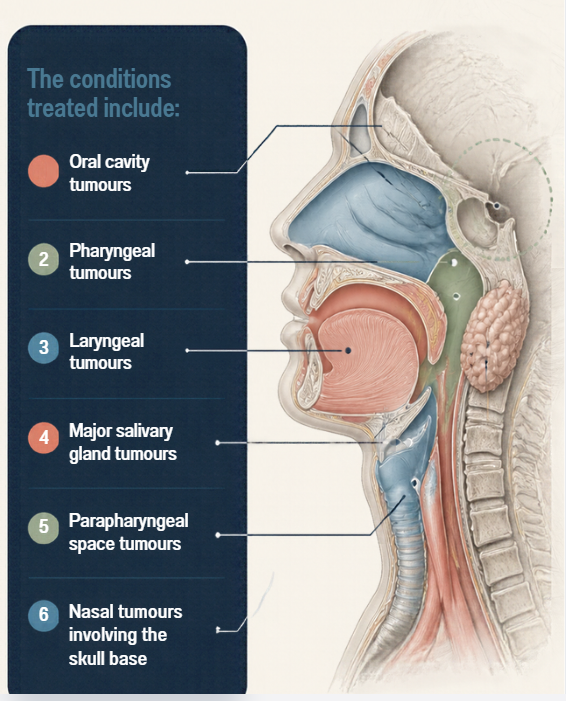
Like other areas of the body, the head and neck region can be affected by cancer. Although these tumours account for approximately 5% of malignant tumours, their impact on quality of life can be considerable, as they may cause loss of voice and difficulties with swallowing and breathing.
SURGICAL PROCEDURES
When surgical removal of the primary tumour is indicated, it is essential to assess its extent and determine whether complete resection is feasible. Although established surgical procedures exist for each anatomical region of the head and neck, treatment must be tailored to the individual patient, taking into account their overall health. The surgeon’s clinical and surgical experience is essential in selecting the most appropriate procedure.
Surgical procedures performed include:
- Cordectomy, partial laryngectomy and total laryngectomy
- Excision of oral cavity tumours
- Excision of oropharyngeal tumours
- Functional endoscopic sinus surgery (FESS) and endoscopic nasal resections
- Salivary gland excision (removal of major salivary glands)
In addition to removal of the primary tumour, most head and neck malignancies require the removal of selected groups of lymph nodes in the lateral neck. These lymph nodes can represent the first route of tumour spread beyond the primary site. Depending on the location and type of tumour, neck dissection may be performed on one or both sides.
- Lateral neck lymph node dissection
HEAD & NECK RECONSTRUCTIVE SURGERY
Following extensive head and neck resections, or surgery for recurrent disease or after radiotherapy, reconstructive procedures may be necessary to restore mucosal or skin continuity.
This reconstruction involves the use of healthy tissue, known as flaps, which may be transferred from nearby areas (pedicled flaps) or from more distant parts of the body (free flaps).
Reconstructive techniques include:
- Pedicled flaps: pectoralis major flap, supraclavicular flap and other techniques.
- Free flaps: radial forearm flap, anterolateral thigh (ALT) flap and other techniques.
MULTIDISCIPLINARY ONCOLOGY CARE
Patient assessment and management follow a multidisciplinary approach involving collaboration among specialists, including maxillofacial surgeons, plastic surgeons, medical oncologists, radiation oncologists, radiologists and pathologists.
The team also includes nurses, speech and language therapists, nutritionists and psychologists. Together, these professionals form the Oncology Multidisciplinary Team (MDT).
A dedicated care pathway, known as the Head and Neck Oncology Diagnostic, Therapeutic and Care Pathway (PDTA), supports the assessment, treatment planning and follow-up of these patients.
This pathway is delivered through a dedicated multidisciplinary oncology outpatient clinic, where patients diagnosed with malignant tumours of the head and neck are assessed, managed and followed over time.

POST-OPERATIVE CARE & REHABILITATION
Voice and Swallowing Rehabilitation
Patients undergoing major oncological surgery for malignant laryngeal lesions—including cordectomy, partial laryngectomy (OPHL) or total laryngectomy—as well as pharyngectomy or oral cavity resection with reconstruction, may require voice and swallowing rehabilitation after discharge.
Rehabilitation begins during the hospital stay and continues through the Phoniatrics Outpatient Clinic, where specialist physicians work closely with speech and language therapists.
Voice Rehabilitation After Total Laryngectomy
The loss of speech can cause considerable psychological distress for patients who have undergone total laryngectomy and have a permanent tracheostoma. However, several voice rehabilitation options can provide effective functional outcomes.
The electrolarynx, a device placed against the neck that produces an artificial, mechanical-sounding voice, is now used less frequently.
An alternative is oesophageal speech, also known as erigmophonic speech. This technique involves the controlled passage of air through the oesophagus to produce sound. Patients who master this technique can achieve encouraging results. Associations for people who have undergone laryngectomy also help teach and support new learners.
Voice prostheses, which have been introduced more recently and are now widely used, provide another effective option. These one-way valves are inserted into a surgically created small opening between the trachea and oesophagus, allowing air from the lungs to be directed through the vocal tract. By using the power of pulmonary airflow, these prostheses can enable highly effective voice production.
Swallowing Rehabilitation
For patients who have undergone partial laryngectomy, restoring swallowing function is also a fundamental rehabilitation goal. Speech and language therapists work with each patient to develop an individualised rehabilitation programme suited to their specific needs.